
The Commodification of the Cool Girl Aesthetic
Goodbye hot girl summer, hello cool girl fall...at least that's what the internet says
By: Savannah Darby
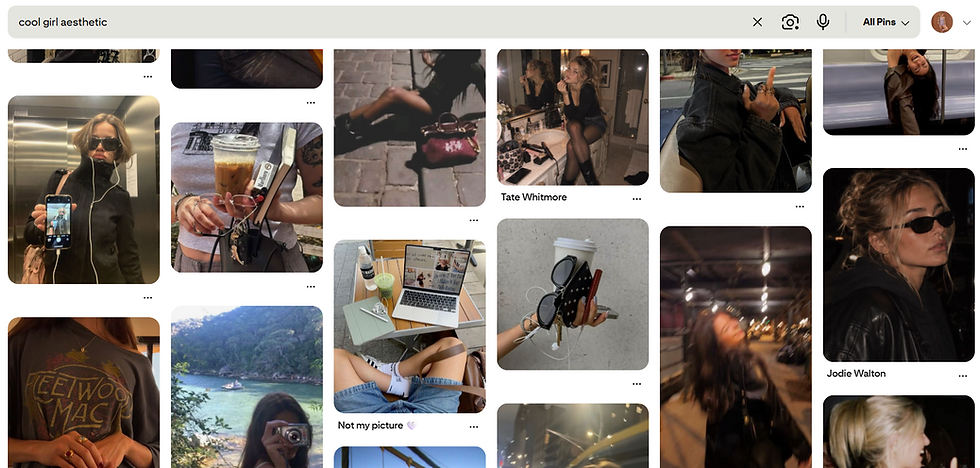
The “cool girl.” The pinnacle of all aesthetics; always evolving, always imitated. We all strive to receive the compliment, yet can’t quite put our finger on exactly what defines it.
The cool girl, the it girl, the new woman. Whatever she may be called, she is ubiquitous within society and has existed across generations.
The first example of the “cool girl” as we know it appeared in the 1920s. The flappers, daring young women defining themselves in new roles within society, began taking up space and dressing in a novel manner that challenged the previous ideas of what a woman was. Even today, people reminisce over the aesthetics of dimly lit jazz bars, cigarettes, fringe dresses, dark makeup and the iconic hairstyles.
This new woman was unique because she was seen and envied by many as she began to appear in famous movie stars and celebrities. For the first time, women had a new standard of comparison and constant exposure to the flapper trend by the growth of movies and Hollywood culture, leading to the imitation of this style among the new generations of adolescent women.
Shockingly, 100 years later, not too far off from the flappers, is the 21st century adjacent: the micro-influencer. The girl who is always on trend and posting her seemingly impossible aesthetic life in a perfectly curated photo dump…that inevitably ends up pinned on everyone’s life inspo board — me included.
It’s no secret that the aesthetic of the cool girl has constantly been subject to change, and in recent years we’ve seen an expansion into more aesthetics than ever. From Y2K to weird girl to clean girl aesthetic, this key observation of the instability of aesthetics brings me to question how we can truly decide what it means to be “cool,” and what the boundary is between genuine “coolness” and imitation.
These trends work through the media and its widespread influence on social norms. From early Hollywood celebrities and the flapper era, to Tiktok and the influencer era, the way people deem what is cool — and what is not — has always been based on media contents.
The cool girl is nothing if not commodified. To be cool is to own — whether it be a product, the latest fashion or makeup trend, new technology — and to constantly be acquiring more. The market needs the cool girl to keep buying into the latest fads, and the media to push them onto her by offering a mode of constant comparison.
This has led to a generation that has issues forming their own identity, growing up enveloped in culture that urges you to follow what is popular in order to be most well-received by others. So much so that even the terminology surrounding things being “underground” or “niche” has been incorporated into its own viral aesthetic, and the art of thrifting or living frugally has become an ironic way to justify overconsumption.
The capitalist market that drives media algorithms thrives on this model of constant consumption, primarily through trend cycles that push young women to feel immense pressure to keep up and maintain an outward appearance of said coolness.
Clearly, we long for uniqueness in our identities, but the pressure of social norms and microtrends water down the creative freedom of self-expression. Where do we draw the line between engaging in forms of self-expression like how we dress, do our makeup and hair or even our hobbies, for the sake of how they will be perceived by those around us rather than for our own genuine engagement? I often find myself wondering how many decisions I make on my own accord and how many are influenced by something I first saw online or something I want to post online.
I’ve been thinking a lot about the paradox between striving for individuality but also grappling with the constant surveillance that social media has over our lives, and the ways it impacts how we present ourselves. The online realm can lead to a world of discovery and connection, but it can also be harmful to those in the vulnerable time of adolescence trying to figure out who they truly are.
The anatomy of a cool girl is the most unstable, yet unavoidable, part of modern womanhood. By being aware of the influence that the pressures of commodification have over our lives, I hope that we (again, me included) can make more conscious choices to strive for genuine joy in our lives — rather than a perfectly curated photo dump.
Savannah Darby is a third-year health science — yes you read that right — major who is still hanging on to her inner Rory Gilmore this fall by writing Rowdy articles and a sporadic Substack post or two... Follow her on insta @savannahdarbyy to see how she tries to be a de-commodified cool girl!


Comments